
Ask a sales rep where the workday happens and Salesforce is rarely the first answer. It is Slack, an email thread, a spreadsheet, or an AI assistant such as Claude. The customer data sits in one system. The work happens in five others.
Salesforce AIforce is the company’s answer to that gap. Announced at Dreamforce on September 15, 2026, it is a live interface layer that brings Salesforce data, workflows, permissions, and governance into the AI tools people use every day. This guide explains what AIforce is, how the architecture works, how it differs from Agentforce, what the security model looks like, and how one manufacturer runs on it today. It closes with Cloud Odyssey’s view on what to do next.
A note on naming: Salesforce CEO Marc Benioff posted on October 9 that AIforce is now SIforce. We cover that below. This guide uses AIforce, the name still on Salesforce’s own product pages as we write.
Key Takeaways
- AIforce is an interface layer. It is not a new CRM, and it does not replace Agentforce.
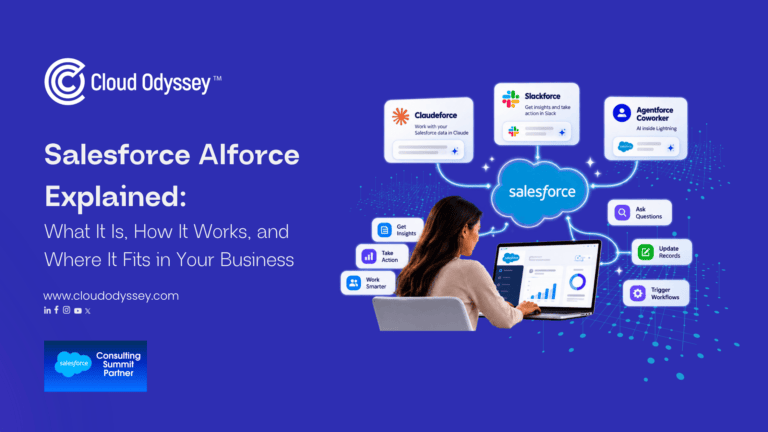
- It launched with three surfaces: Claudeforce (inside Claude), Slackforce (inside Slack), and Agentforce Coworker (inside Lightning). The Headless Toolkit powers all three.
- Each request runs on the user’s existing Salesforce permissions. Salesforce states that business data is not retained by the model provider.
- Claudeforce ships with 37 prebuilt sales skills and is in beta for all customers.
- BACA Systems, a 50-person manufacturer, projects about $200,000 in annual savings from a payments app built on this headless approach.
- The results depend on what sits underneath: clean data, tight permissions, and governed integrations.
What Is Salesforce AIforce?
Salesforce AIforce is a live interface layer that brings the data, workflows, business logic, permissions, and governance inside Salesforce to any AI interface, including Claude, Slack, and Lightning. Users no longer need to open the Salesforce app to ask questions, update records, or trigger workflows.
That definition comes from Salesforce’s AIforce announcement, and the examples in it make the idea concrete. In Slack, Slackbot can surface which accounts are going quiet, read the support cases and Slack threads behind them, reassign the owner, create a follow-up task, and draft a win-back email. The rep never opens a Salesforce tab.
AIforce also lets people describe the interface they want and receive a working one. A support lead can ask for a view of open cases sorted by response time. A rep can ask for accounts nearing renewal. Salesforce’s customer Engine, which handles about 800,000 customer inquiries a year, described this as getting a working interface from data the team already owns, without waiting for someone to build a dashboard.
Salesforce’s own AIforce page draws a useful line. AIforce is the bigger idea. Products such as Salesforce in Claude are single examples of it.
Why Did Salesforce Build AIforce?
Salesforce says much of a company’s knowledge already lives in its platform, but most people could reach it only by opening the app and moving through screens. That limited three things: who could use Salesforce, how much information they could see at one time, and how much value they could pull out.
The third limit is the one agents change. A person can scroll through a few records. An agent can read across hundreds at once, pull in connected systems, and reason over the full picture. Benioff described the shift as an interface revolution, where model intelligence meets the business context customers have built into Salesforce over many years.
There is a plain commercial point here too. Teams already spend their day in Claude, Slack, and Microsoft tools. Salesforce chose to meet them there instead of asking them to log in.
How Does Salesforce AIforce Work?
The flow has five steps. Salesforce’s documentation and announcement describe each of them.
- A person or an agent makes a request in Claude, Slack, or Lightning. For example: “Which of my accounts have gone quiet this month?”
- The AI tool calls Salesforce through the Headless Toolkit, using an MCP server, an API, or a prebuilt skill.
- Salesforce checks identity and permissions. According to the Salesforce developer documentation, each hosted MCP transaction runs as the authenticated user. Object permissions, field-level security, sharing rules, and permission sets all apply.
- The AI reasons over the results. It reads the records, the cases, and any connected context, then decides on an answer or an action.
- The action routes back through Salesforce. Updates, tasks, and emails follow the same business rules and leave an audit trail tied to the user.
The rule that holds the whole design together is short. If you cannot do something in Salesforce, your agent cannot do it through the MCP server either.
What Is the AIforce Architecture?
Salesforce describes AIforce as the top layer of its Agentic Enterprise architecture. Each layer sits on the one below it.
| Layer | What it does |
| AIforce | Brings the full foundation to any AI interface: Claude, Slack, Lightning, and more |
| Agentforce | A digital workforce with ready-to-deploy agents and a builder for custom ones |
| Customer 360 | The application and semantic layer: business logic, processes, permissions, and actions across sales, service, marketing, and commerce |
| Data 360 | The unified data layer: harmonized and federated data, metadata, and memory |
The Headless Toolkit is the connective tissue. It exposes the platform through MCP servers, APIs, plug-ins, and skills so that agents and developers can reach it without the Lightning UI.
The toolkit has a short history. Salesforce announced it as Headless 360 at TrailblazerDX in April 2026, and Salesforce’s developer blog calls it the biggest theme of the Summer ’26 release. Salesforce Help carries release notes on Headless 360 for admins who want the change log. Salesforce announced hosted MCP servers as generally available in April 2026, and a Headless 360 MCP server entered beta in July.
This stack is why we keep telling clients that AIforce is a data and integration question before it is an AI question. Our Data Cloud implementation work starts at the bottom layer for that reason.
What Are the Parts of AIforce? Claudeforce, Slackforce, Agentforce Coworker, and the Headless Toolkit
Claudeforce: Salesforce Inside Claude
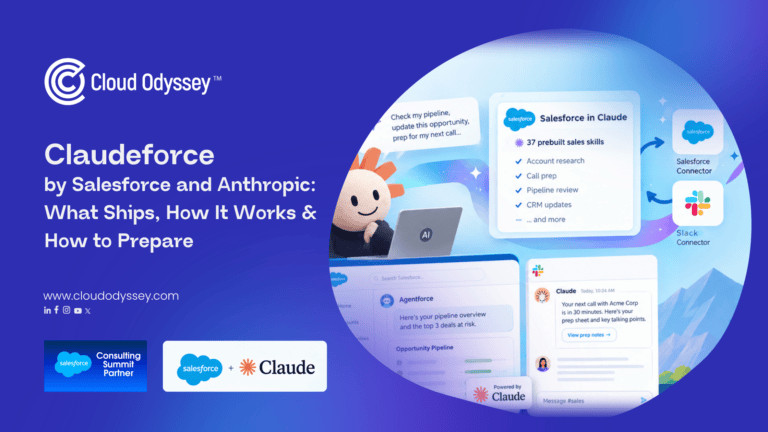
Claudeforce is the partnership between Salesforce and Anthropic. Its first product, Salesforce in Claude, gives Claude a prebuilt Salesforce MCP server and 37 ready-to-use sales skills, from prospecting to pipeline hygiene. Setup needs no custom skill mapping.
Builders get a separate tool: the Salesforce Development plug-in for Claude Code, with more than 40 skills. Deloitte, GitLab, and Legora piloted Salesforce in Claude, and it is now in beta for all customers. Salesforce plans to add Tableau analytics and skills for service, marketing, commerce, and industries.
For a deeper look at what ships and how to prepare, read our guide to Claudeforce by Salesforce and Anthropic.
Slackforce: Salesforce Inside Slack
Slackforce has four parts:
- Slackforce Surfaces are live, shared interfaces that teams can filter, comment on, and act on together.
- Slackbot is a personal assistant that reasons over Slack conversations and governed Salesforce data.
- Slack CRM lets users create accounts, log call notes, and update records from a prompt in Slack.
- Slack Code gives teams a shared space to build with a coding agent.
Teams that run revenue operations in Slack will see the most immediate fit. We covered the earlier version of this idea in our post on how Agentforce turns Slack into an AI revenue operations assistant.
Agentforce Coworker: An AI Teammate in Lightning
Agentforce Coworker lives inside the Lightning interface. It reasons across accounts, activity, and history, then surfaces insights and takes action within existing permissions and business rules. It also calls the Agentforce agents a company has already deployed, which makes it a front door to the agent workforce.
Salesforce reports that 100,000 users activated Coworker in its first 35 days. Fulton Bank went from zero to more than 20 live use cases for about 3,000 users in a few weeks. Both figures come from Salesforce’s announcement.
The Headless Toolkit: Build Your Own Experience
The toolkit is for teams that want something the packaged products do not cover. You choose which Salesforce features to expose, and you connect them to your own tools and interfaces. Salesforce states that this is optional. The ready-made experiences work without developer effort.
AIforce vs Agentforce: What Is the Difference?
Agentforce is the digital workforce. AIforce is the interface layer that lets people and agents reach that workforce, and the rest of Salesforce, from outside the Salesforce app.
| Agentforce | AIforce | |
| What it is | Salesforce’s product for building and running AI agents | An interface layer for using Salesforce in other tools |
| Main job | Do the work: qualify leads, resolve cases, handle refunds | Decide where the work can be requested and seen |
| Where you use it | Wherever an agent is deployed | Claude, Slack, Lightning, and other AI tools |
| Who builds on it | Admins and developers using Agentforce Builder | Teams using packaged surfaces or the Headless Toolkit |
| Relationship | Stays a separate layer | Sits on top and supplements it |
Salesforce Ben, which covered the Dreamforce keynote, reports that Salesforce addressed this question directly. Agentforce stays its own layer and does not fold into Claudeforce or AIforce. Coworker is the bridge, because it routes work to agents you have already built.
If you are still weighing Agentforce itself, our Agentforce services page covers where we start.
Is Salesforce AIforce Secure? Permissions, Zero Data Retention, and MCP Governance
Security is the first question every CIO asks about agents that act from outside the CRM. Salesforce’s answer has four parts.
Existing permissions apply. Every request runs on current permissions and business rules, so an agent sees only what the person asking can see. There is no new permission model to build.
Hosted MCP servers are locked down by default. Per Salesforce’s developer guidance, all MCP servers are inactive until an admin turns them on. Access runs through an External Client App with the mcp_api scope, and MCP activity is logged through Event Monitoring. Salesforce also recommends configuring your MCP client to ask for approval before any tool that changes configuration or alters or deletes data.
Agent identity is getting its own tooling. At Dreamforce, Salesforce said Agentic Identity will reach general availability in November. The idea is that an agent may need only a subset of what its human user can do.
Zero Data Retention (ZDR) is the headline trust claim. Salesforce states that business data is used to answer the question at hand and is not retained by the model provider or used to train models. One caution applies. When Salesforce Ben published its guide on September 18, it noted that the claim was announcement-driven and that independent verification had not been published. We suggest confirming ZDR terms in your contract and security review, the same way you would for any vendor.
Pricing and packaging can change, and availability varies by region, according to the notice on Salesforce’s announcement. Confirm both with your Salesforce account team or partner before you plan a rollout.
Is AIforce Now Called SIforce?
Possibly, and the situation is moving. On October 9, Marc Benioff posted on X that AIforce is officially SIforce, tied to the industry’s rising use of the term super intelligence. Salesforce Ben reported on October 12 that no official Salesforce announcement had followed. It also noted that this is the third name for the same capability in about six months: Headless 360, then AIforce, then SIforce.
As of October 14, Salesforce’s own AIforce page still uses the AIforce name. We expect people to search for both terms for some time.
Our advice is practical. Names change. Permissions, data models, and integrations do not. Plan around those, and treat the brand as a label.
AIforce Business Use Case: How BACA Systems Runs a 50-Person Manufacturer on One Platform
The clearest published example of the headless approach comes from Salesforce’s own customer story on BACA Systems.
The company. BACA is one of three leading U.S. makers of stone fabrication equipment. It builds robotic systems for the industry. Its VP of Business Systems, Andrew Russo, is also its only Salesforce admin.
The problem. BACA ran Sales Cloud and Service Cloud for customer-facing work. Inventory, procurement, accounts payable, accounts receivable, work orders, and field service sat in separate tools. Field technicians logged expenses in Concur, and someone re-entered them in Salesforce. Field teams coordinated by text message, with no link back to a project record. Many employees do not sit at a desk, so a desktop CRM screen was the wrong tool for them.
What they did. Starting in 2022, BACA moved as much of its operation as it could onto Salesforce, using Flows, targeted Apex, and AppExchange apps. The org now holds nearly 1,300 custom objects and more than 700 flows, and it runs Rootstock ERP, which is built natively on Salesforce. On top of that foundation, BACA took the headless route:
- An Inventory Agent in Slack, built on Agentforce, answers material availability and purchase order questions. It handles 70 to 80 percent of those queries.
- Agentforce Coworker supports conversational search. A staff member asked for customers who ordered last year but not this year, and the resulting outreach list led to two live demos within a week.
- A Slack channel for each field project lets technicians log time and run Salesforce quick actions without opening the full UI.
- A custom payments module lets customers pay by ACH instead of card, which removes a 3.5 percent card fee. Salesforce says BACA projects savings of about $200,000 a year.
- Security and testing run on Salesforce Shield Event Monitoring and Full Copy sandboxes, so agents are tested against a 1:1 copy of the production metadata before they reach employees.
The reported results.
| Outcome | Reported figure |
| Payment processing fees | About $200,000 saved per year |
| Collections labor | 20 hours per week eliminated |
| Time lost searching for information | One hour saved per team member per day |
| Time and expense billing | Zero missed billings on service projects |
How to read this story. Salesforce published it, and the savings are projections, so treat the numbers as directional. BACA is also an unusual case. Its ERP runs natively on Salesforce, which removes the biggest integration problem most enterprises face. The lesson that carries over is the pattern. Put the data and business logic in one governed place, then let each team reach it from the tool it already uses.
What Could AIforce Look Like for a Company With SAP, Oracle, or NetSuite?
Most organizations do not run their ERP on Salesforce. Here is an illustrative scenario, not a client result.
A mid-size manufacturer keeps accounts and opportunities in Salesforce and finance in SAP. A sales manager asks Slackbot, “Which of my accounts have open invoices over 60 days and an upcoming renewal?” Salesforce holds the renewal dates. SAP holds the invoices. The answer needs both.
AIforce can reach the Salesforce half through the Headless Toolkit. The SAP half needs a governed API layer, and this is where MuleSoft integration earns its place. Salesforce also states that MuleSoft is the integration route for agents that need to act across systems, and we explain the governance side in our post on MuleSoft Agent Fabric. Without that layer, the agent answers half the question.
How Do You Get Ready for AIforce? A Six-Point Checklist
- Check the data foundation. Agents reason over what they find. Duplicate accounts, stale fields, and unclear definitions produce confident wrong answers. A Salesforce CRM health check is the fastest way to see where you stand.
- Clean up permissions. Agents inherit permission sets, sharing rules, and field-level security. A user with too much access becomes an agent with too much access. Review profiles before you connect anything.
- Map the systems outside Salesforce. List where orders, invoices, inventory, and contracts live, and decide which need governed APIs.
- Decide your MCP policy. Choose which servers to activate, who can connect, and which tool calls need human approval.
- Pilot with one team and one surface. Sales teams can start with Salesforce in Claude. Teams that live in Lightning can start with Coworker. Measure time saved and answer quality for 30 days.
- Plan for monitoring. Agent activity needs the same logging and review as any other privileged access. Our Salesforce managed services cover this after go-live.
Organizations running Sales Cloud, Service Cloud, or Manufacturing Cloud can apply this list to each cloud in turn. For companies with several clouds, our multi-cloud implementation guide covers sequencing. Teams in India who need local data residency for integrations can read our post on MuleSoft on Hyperforce in India.
Cloud Odyssey’s Point of View on Salesforce AIforce
We have implemented Salesforce and MuleSoft for clients since 2014, and AIforce confirms a trend we have watched build for two years. The screen is becoming optional. The data model, the permissions, and the integrations are the product.
Here is where we stand.
AIforce speeds up whatever sits underneath it. A clean org gets faster. A messy org gets messy faster, and now the mess shows up in Slack and Claude as well as Lightning. Most AIforce problems we expect to see are old problems: overgrown permission sets, duplicate records, and brittle integrations.
Start with the packaged surfaces. Run a Claudeforce or Coworker pilot before you build a custom headless experience. Build custom only when the standard surfaces fail to fit a real workflow.
Treat the brand names as unstable. Three names in six months is a signal. Write your architecture decisions in terms of capabilities, such as MCP access, permissions, and ZDR terms, and not product labels.
Ask for proof on trust claims. Zero data retention is a strong commitment. Ask your account team for the contractual language and the audit evidence, and have your security team review both.
Do the foundation work first. The most useful AIforce project we can run with you often starts as a health check, a data review, and an integration plan. That work makes every later Salesforce release easier to adopt.
Cloud Odyssey is a Salesforce Summit Partner and a MuleSoft partner, headquartered in the UK with offices in the US, India, and Singapore. Our team includes more than 350 certified experts holding over 700 certifications across Salesforce and MuleSoft. We were named UKI Implementation Partner of the Year in 2024 and India Multi-Cloud Partner of the Year in 2026. You can read more about Cloud Odyssey, see our customer success stories, or follow our Dreamforce 2026 takeaways for the wider picture.
If you are planning an AIforce pilot, our Salesforce consulting services and Salesforce implementation services teams can help you scope it. Contact Cloud Odyssey to start with a conversation.
Frequently Asked Questions About Salesforce AIforce
Salesforce AIforce is a live interface layer that brings Salesforce data, workflows, business logic, permissions, and governance into AI tools such as Claude, Slack, and Lightning. Salesforce announced it at Dreamforce on September 15, 2026.
No. Agentforce is Salesforce’s product for building and running AI agents. AIforce is the layer that lets people and agents use Salesforce, including Agentforce agents, from other tools. Agentforce Coworker connects the two by calling the agents you have deployed.
No. Claudeforce is one AIforce experience. It covers Salesforce in Claude, which includes a prebuilt MCP server and 37 sales skills, plus a plug-in for Claude Code. AIforce also includes Slackforce, Agentforce Coworker, and the Headless Toolkit.
No, not for the ready-made experiences. Salesforce states that products such as Salesforce in Claude work with minimal setup. The Headless Toolkit is for teams that want to build something tailored, and it is optional.
Salesforce states that it does not. Under its Zero Data Retention commitment, business data is used to answer the question and is not retained by the model provider. Review the contract terms and your security requirements before you rely on the claim.
Salesforce’s CEO said on October 9, 2026 that AIforce is officially SIforce. At the time of Salesforce Ben’s report on October 12, Salesforce had not published an official announcement, and Salesforce’s own AIforce page still used the AIforce name. The capability described in this guide stays the same under either name.
Salesforce says pricing and packaging are subject to change and that availability varies by region. Ask your Salesforce account team or implementation partner for current terms in your region.
Start with a data and permissions review, map the systems outside Salesforce, set an MCP policy, and run a 30-day pilot with one team. The checklist above covers each step.