
For years, MuleSoft has helped organisations address one of the biggest challenges in enterprise technology: connecting applications, data, and systems across increasingly complex environments. By enabling seamless integration through APIs, MuleSoft has become a critical part of how businesses modernise operations, improve experiences, and maximise the value of their technology investments.
As organisations embrace AI, modernise legacy infrastructure, and manage growing volumes of data, integration has become increasingly important. Against this backdrop, the availability of MuleSoft on Hyperforce in India marks an important milestone, combining MuleSoft’s integration capabilities with Salesforce’s next-generation cloud infrastructure to help organisations align supported integration workloads with local data residency, governance, and regulatory requirements.
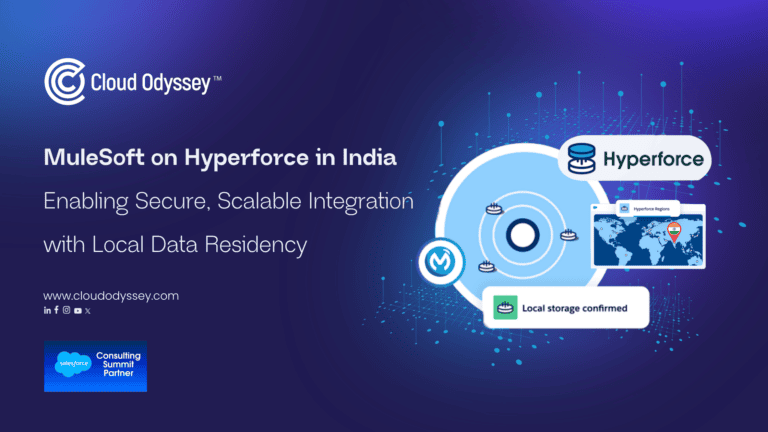
MuleSoft on Hyperforce is now available for India Cloud control plane deployments, enabling eligible organisations to deploy supported MuleSoft workloads with Indian data residency.
In this blog, we explore what MuleSoft on Hyperforce means for organisations in India, the capabilities it introduces, and how it supports secure, scalable integration while laying the foundation for future AI initiatives.
Why MuleSoft on Hyperforce Matters for Indian Enterprises
Today’s organisations operate across an expanding landscape of applications, cloud platforms, data sources, and legacy systems. As digital transformation accelerates, data becomes increasingly distributed, making it more difficult to access, govern, and utilise effectively.
At the same time, businesses are expected to deliver connected customer experiences, improve operational efficiency, and respond more quickly to changing demands. These priorities rely on seamless access to data and applications across the enterprise.
For organisations in India, these challenges are accompanied by evolving data residency, governance, and regulatory considerations, particularly in industries where the location and management of data are business critical. Organisations increasingly need integration platforms that support innovation while helping them align with these requirements.
What is Hyperforce and How Does it Support MuleSoft in India?
Hyperforce is Salesforce’s next-generation cloud infrastructure architecture, built on leading public cloud providers to deliver enhanced scalability, security, agility, and regional deployment capabilities. By enabling supported customer data and integration workloads to be stored and processed within specific geographic regions, Hyperforce helps organisations align their technology landscape with data residency and governance objectives while benefiting from modern cloud infrastructure.
For organisations deploying MuleSoft in India, this includes an India-based Anypoint Platform control plane together with support for CloudHub 2.0 deployments in the India region. Supported capabilities include API Manager, Runtime Fabric, Object Store v2, Anypoint MQ, API Governance, Private Spaces, VPN connectivity, and Omni Gateway, providing a locally hosted foundation for supported integration workloads.
Availability may vary by feature, subscription, deployment model, and control plane, so organisations should validate the latest supported feature matrix as part of their architecture and deployment planning.
What MuleSoft on Hyperforce Brings to Indian Organisations
Local Data Residency and Regulatory Alignment
For many organisations, particularly those operating in regulated industries, understanding where integration workloads are stored and processed is an important consideration.
MuleSoft on Hyperforce in India enables organisations to operate Anypoint Platform with an India-based control plane and CloudHub 2.0 runtime support for eligible workloads. This allows supported integration and API workloads to be stored and processed locally, helping organisations align their integration architecture with data residency, governance, and sector-specific regulatory requirements.
At the same time, organisations remain responsible for validating end-to-end compliance obligations, including how connected systems, third-party services, and cross-border data flows fit within their legal and industry requirements.
API Security, Governance, and Enterprise Integration
As organisations expand their integration landscape, security extends beyond infrastructure alone.
Hyperforce provides a secure cloud foundation through modern security controls and encryption capabilities. MuleSoft complements this with API security, policy enforcement, governance, and controlled access across integrations through capabilities such as API Manager and API Governance. Together, they help organisations build a trusted integration environment while maintaining visibility and control across enterprise APIs.
Scaling Enterprise APIs and Integration Workloads
As organisations introduce new applications, APIs, and digital services, integration requirements continue to evolve.
Hyperforce provides infrastructure designed to support growing integration demands. At the same time, production scalability and resilience continue to depend on sound API design, messaging patterns, runtime configuration, and overall integration architecture.
Accelerating Digital Transformation Through API-Led Connectivity
Successful digital transformation depends on the ability to connect applications, data, and business processes efficiently.
By providing a cloud-native environment for integration, MuleSoft on Hyperforce helps organisations simplify connectivity across their technology landscape, enabling teams to build, deploy, and manage integrations more effectively while responding faster to changing business requirements.
For example, organisations in banking, insurance, and financial services can use locally hosted APIs and governed integrations to support onboarding journeys, connect customer and compliance systems, improve auditability, and prepare for AI-driven servicing experiences while aligning with data residency and governance requirements.
Building an AI-Ready Enterprise with MuleSoft and Hyperforce
As organisations move from AI experimentation to production use cases, access to trusted enterprise data through well-governed APIs becomes increasingly important. AI initiatives depend on reliable connectivity between systems, applications, and business processes, making integration a foundational capability rather than a standalone technology.
Without connected systems and governed access to enterprise data, organisations may struggle to realise the full value of AI initiatives. MuleSoft helps provide this integration layer by connecting applications, data, and processes through reusable, governed APIs, enabling more intelligent workflows and AI-enabled business processes.
As organisations adopt AI agents, MCP-enabled tools, and intelligent automation, capabilities such as governed APIs, Omni Gateway, audit trails, and data masking or tokenisation become increasingly important for maintaining visibility, security, and control across AI interactions and enterprise systems.
MuleSoft on Hyperforce in India further strengthens this foundation by supporting locally hosted integration workloads. For each AI use case, organisations should also evaluate the residency and processing locations of external AI models, embedding services, vector databases, observability platforms, and other third-party services that may interact with enterprise data.
Use Case: Secure Digital Loan Onboarding with MuleSoft on Hyperforce in India
Consider an Indian bank or NBFC looking to modernise its digital loan onboarding process while aligning integration workloads with local data residency and governance requirements.
A customer applies for a personal loan through a mobile app, web portal, or Salesforce-powered service channel. The application journey requires data to move securely across multiple systems, including Salesforce, core banking platforms, credit bureau services, KYC verification providers, document management systems, payment systems, notification services, and analytics platforms.
With MuleSoft on Hyperforce in India, the organisation can build a governed API-led integration layer where supported integration workloads run through an India-based Anypoint Platform control plane and CloudHub 2.0 deployments in the India region.
A high-level architecture may include:
- Experience APIs to expose loan application status to mobile applications, customer portals, branch users, and contact centre agents.
- Process APIs to orchestrate customer onboarding, KYC checks, credit eligibility assessments, document verification, loan approval workflows, and disbursement processes.
- System APIs to securely connect Salesforce, core banking systems, credit bureaus, payment gateways, document repositories, notification services, and analytics platforms.
- Anypoint MQ to decouple long-running processes such as document verification, credit checks, and downstream notifications.
- API Manager and API Governance to apply security policies, rate limits, client access controls, API standards, and governance rules.
- Object Store v2 to manage idempotency, correlation IDs, temporary state management, and retry handling.
- Private Spaces and VPN connectivity to securely connect MuleSoft workloads with private banking systems and on-premises applications.
- Omni Gateway and governed AI access patterns to support future AI use cases such as loan document summarisation, eligibility explanation, agent-assisted customer service, and risk reviews, while ensuring AI-related data flows are assessed for residency, security, and audit requirements.
This architecture helps organisations reduce point-to-point integrations, improve reuse across digital channels, increase visibility into API traffic, and maintain stronger control over sensitive customer and financial data. It also creates a foundation for AI-enabled banking workflows where enterprise data is accessed through governed APIs rather than uncontrolled system-level access.
The result is a more secure, scalable, and governed integration foundation for digital lending, customer onboarding, service automation, and future AI-driven financial services initiatives.
What Organisations Should Evaluate Before Adopting MuleSoft on Hyperforce
As organisations evaluate MuleSoft on Hyperforce in India, it is worth considering how the platform aligns with existing technology, operational, and regulatory requirements. Key questions include:
- Which MuleSoft services and capabilities required by the organisation are available in the India region?
- Which deployment model, CloudHub 2.0, Runtime Fabric, or a hybrid approach, best aligns with operational requirements?
- Where will integration data, logs, messaging services, and connected workloads reside?
- How do external SaaS applications, AI services, analytics platforms, or other third-party tools interact with enterprise data?
- What disaster recovery and business continuity requirements need to be addressed as part of the overall integration architecture?
The Future of Integration and AI in India
The availability of MuleSoft on Hyperforce in India reflects the growing demand for integration platforms that support security, governance, scalability, and evolving data residency expectations together rather than as separate priorities.
By combining MuleSoft’s API-led integration capabilities with Hyperforce’s cloud infrastructure, organisations gain a locally hosted foundation for supported integration workloads while preparing for future innovations across API management, governance, automation, and AI.
For organisations across India, MuleSoft on Hyperforce represents more than a new deployment option. It provides a locally hosted foundation for integration, API governance, and future AI initiatives, while organisations continue to retain responsibility for validating end-to-end data flows, regulatory obligations, and service-specific capabilities within their own environments.
At Cloud Odyssey, we see MuleSoft on Hyperforce in India as more than a regional infrastructure milestone.
As organisations modernise legacy systems, expand their digital ecosystems, and move from AI experimentation to enterprise-scale adoption, integration increasingly becomes the layer that determines how securely and effectively innovation can scale.
Local deployment capabilities can help simplify conversations around data residency and governance, but long-term success still depends on architecture decisions, API strategy, security controls, and operational discipline.
In our experience, organisations that derive the greatest value from integration platforms are those that treat integration not as a project, but as a strategic capability that supports customer experience, operational agility, and responsible AI adoption across the enterprise.
MuleSoft on Hyperforce in India provides an important foundation for that journey.
Frequently Asked Questions
No, it supports compliance rather than delivering it. Local hosting of supported workloads removes one common obstacle, but the organisation still owns its end-to-end obligations: sector regulator requirements, contractual commitments, third-party processors, encryption and access controls, and how every connected system handles personal data.
Not automatically. The India control plane and CloudHub 2.0 region cover supported MuleSoft workloads. Logging and monitoring destinations, messaging, connected SaaS applications, external AI services and any cross-border flows each have their own processing locations and need to be checked separately. Mapping every data flow end to end is architecture work; it is not something a region setting resolves on its own.
Existing deployments continue to run. Moving is a migration decision, and it typically involves confirming that the capabilities you depend on are available in the India region, planning the control plane and application migration, re-establishing connectivity such as Private Spaces and VPN, carrying over API policies and client contracts, and retesting. Plan it as a migration with a cutover, not a configuration change.
No. CloudHub 2.0 in the India region is the fully managed option, while Runtime Fabric remains available for organisations that prefer to run runtimes on infrastructure they manage themselves. Hybrid combinations are common, particularly where certain workloads need to sit close to on-premises systems. The right mix depends on operational ownership, latency and internal connectivity.
Yes. Private Spaces and VPN connectivity are used to reach private networks, so integrations can talk to core banking platforms, ERP systems and other applications that remain in your own data centre. That is what makes a phased approach workable: a cloud-hosted integration layer, on-premises systems of record, and controlled connectivity between the two.