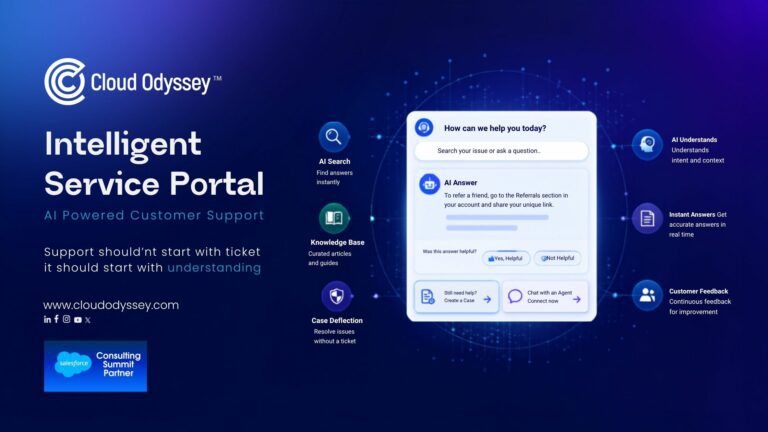

Case deflection in Salesforce is the practice of resolving a customer query inside the service portal before a case is ever created. A deflection first design verifies the user, retrieves a grounded answer, records the outcome as a measurable signal, and opens a case only when retrieval genuinely fails.
Why Most Salesforce Self Service Portals Still Create Unnecessary Cases
Look at how a typical support portal is assembled. There is a Contact Support form, and somewhere near it, a knowledge search box or a panel of suggested articles. The form is the primary action. Knowledge is the decoration around it.
That layout has decided the outcome before the customer has typed anything. The path of least resistance leads to a case record, so a case record is what you get, including from the customer who only wanted to know how the referral scheme works or where last month’s invoice went.
The cost is almost never visible in a single interaction. It shows up in aggregate. Every unnecessary case consumes a routing decision, an owner, an SLA clock, a context switch for an agent who was working on something harder, and a closure note nobody will read. Support teams then report on how quickly they cleared a queue they generated themselves.
The problem worth solving is not how to handle support volume faster. It is how much of that volume should have existed.
What Case Deflection Actually Means Inside Salesforce
Case deflection is any interaction where a customer arrives intending to raise a support request and leaves with the answer instead. Salesforce splits it into two forms. Explicit deflection is when the customer begins creating a case, sees relevant content, and abandons it. Implicit deflection is when the customer finds the answer in self service and never starts a case at all.
The distinction matters because only one of them is instrumented for you.
Experience Cloud ships a deflection signals framework built around a lightningcommunity:deflectionSignal event. According to the Salesforce developer documentation, that event fires when a user starts a case, views a deflection item that addresses the issue, and abandons the case as a result. Those events are reportable through custom report types targeting the Community Case Deflection Metrics object, and each one is classified as a successful deflection, a failed deflection or a potential deflection.
That is the platform floor. Everything worth designing sits above it, in what you choose to retrieve, when you choose to stay quiet, and what you decide to record.
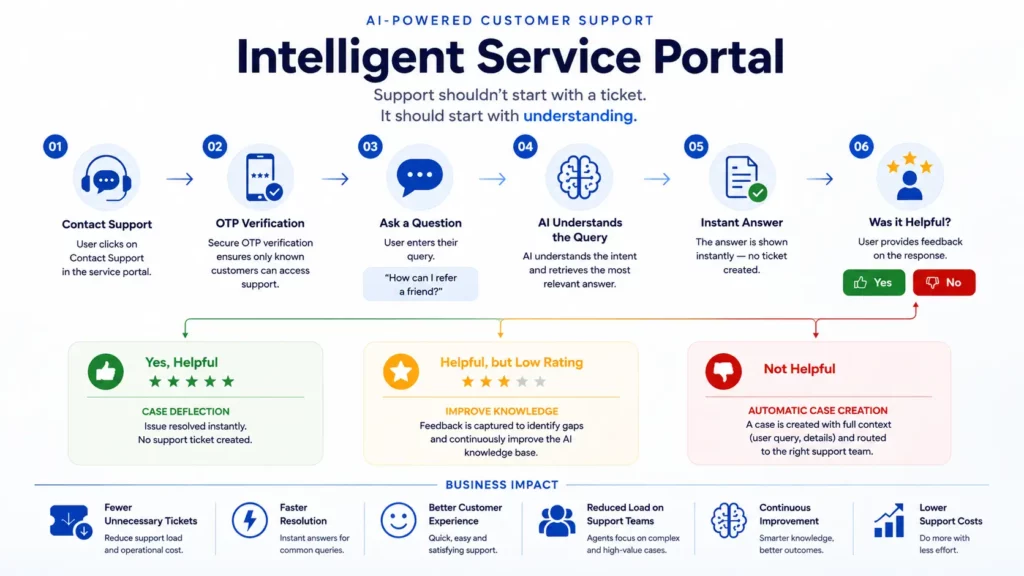
Identity Verification Belongs Before the Query, Not After
Most portals treat authentication as a step you hit when you finally submit something. Moving verification to the front of the journey, before the customer has typed a query, changes two things.
The first is answer quality. A verified user arrives with entitlements, purchased products, order history and account context. Retrieval can then be scoped to what is actually true for that person rather than to a generic public article set. A question about a refund window has a different correct answer depending on the plan someone is on, and a portal that cannot tell the difference will confidently give the wrong one.
The second reason is the one teams tend to discover late. The Salesforce documentation is explicit that only deflection signal events triggered by authenticated users are reported. An anonymous visitor who searches, finds the answer and closes the tab is invisible to your reporting. Your portal can be deflecting well and showing nothing for it.
So a one time passcode at the entry point is not friction added for its own sake. It is what makes the deflection layer both personalized and countable. If you also want a public knowledge path for prospects and unverified visitors, design it deliberately as a read only route with no case creation, and accept that it sits outside your deflection reporting rather than quietly distorting it.
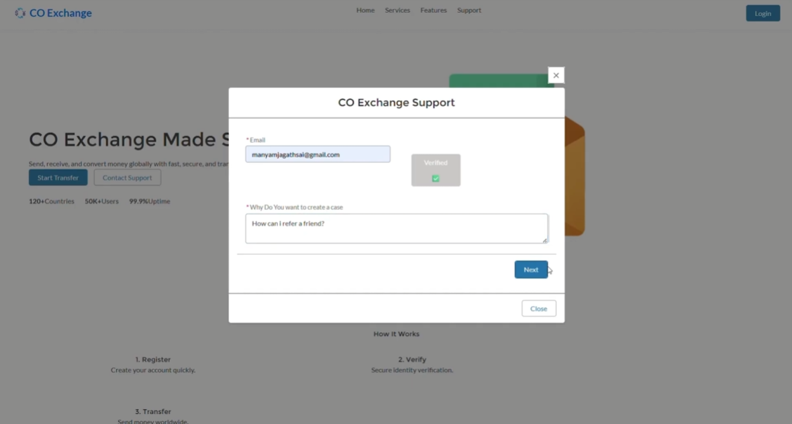
Verification is resolved before the query is acted on, and the case reason field only submits once identity is confirmed.
Retrieval Before Case Creation Inverts the Portal Default Path
The architectural change is small to describe and significant to build. The customer query becomes the input to a retrieval step. It is no longer the description field on a case record that has already been created.
In current Salesforce, that retrieval layer is usually an Agentforce Data Library, which indexes Knowledge articles and attachments and grounds responses through retrieval augmented generation, or a custom retriever built in Data Cloud against a search index when you need tighter control over what comes back.
Two implementation notes that save weeks:
- Keep the retriever narrow. Returning every available field costs tokens and dilutes the answer. Return the chunk that holds the content plus the identifiers you need for citation, and nothing else.
Check permissions before you blame content. An Agentforce Service Agent runs as its own platform user. Without a permission set granting Knowledge access, that user retrieves nothing, and the symptom looks exactly like a knowledge gap. More than one team has spent a week rewriting articles to fix what was an access problem.
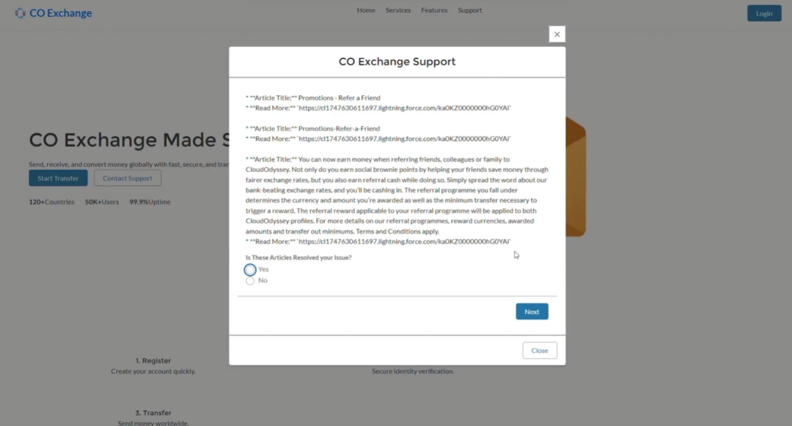
Retrieval surfacing grounded Knowledge articles before any case is created, and the customer confirms the query is resolved.
Only after retrieval has been attempted, and the result has been put in front of the customer, does the design decide whether a case is warranted.
| Design point | Ticket first portal | Deflection first portal |
| What the query becomes | The description field on a case that already exists | The input to a grounded retrieval step |
| Default outcome | A case record | An answer, with a case as the exception |
| Identity check | At submission, if at all | At entry, before the query is typed |
| Agent first action | Working out what the customer meant | Solving the problem |
| What gets measured | Case volume and time to close | Confirmed deflections, retrieval failures and repeat contact |
Confidence Thresholds Decide When the Portal Should Stay Quiet
The failure mode of an AI support portal is not silence. It is confident wrongness.
A retrieval layer that is required to produce an answer will produce one even for queries it has no grounding for. Those answers deflect cases that should have escalated. You see the consequence about two weeks later, as repeat contacts on the same topic and a satisfaction score nobody can account for.
Set a retrieval confidence floor, then design the behaviour underneath it. Below the floor, the portal should say plainly that it does not have a reliable answer and offer the escalation path, rather than assembling something plausible. Instruct the agent explicitly not to fall back on general model knowledge when grounded sources return nothing. If you add a web search data library as an intermediate fallback, scope it tightly, because anything presented inside an authenticated support portal reads to the customer as an official answer from you.
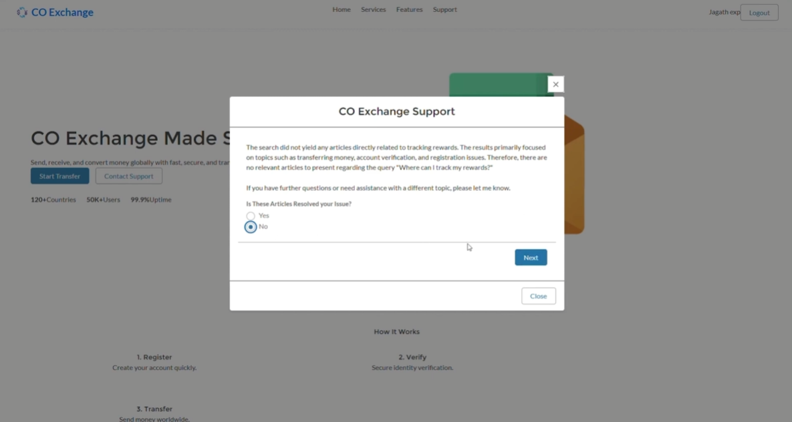
No relevant articles found. The portal says so plainly instead of guessing, and the customer confirms the issue is unresolved.
A clean refusal that routes correctly costs one interaction. A plausible wrong answer costs three.
Record the Deflection Rather Than Simply Avoiding the Case
If a resolved query leaves no trace, your reporting shows a quiet month rather than a working system.
Every resolved interaction should write a record carrying the query as the customer phrased it, the source that was retrieved, the timestamp, the verified identity, the confirmation of resolution and the rating. Three things depend on that record existing.
- You cannot prove the return without it. Deflection value is calculated against your fully loaded cost per case, and that calculation needs a countable numerator.
- You cannot separate deflection from abandonment without it. A session that ends without a case looks identical to a session where someone gave up, unless you captured an explicit confirmation.
- You lose the demand signal without it. The queries customers actually type are the most honest product and content research you will ever be handed, and they only exist if you store them.
Salesforce makes the same argument from the agent side, recommending that reps attach the knowledge article to every case they close so that content is measurably linked to resolution. Apply the identical discipline on the deflection path. A deflection with no source reference is not auditable.
A Helpful Answer With a Low Rating Is the Signal Most Teams Discard
Here is the record worth building a process around. The customer confirms the issue is resolved, then rates the answer poorly.
A binary helpful or not helpful control collapses that into a success and throws the information away. It is not a success. It usually means the answer was correct but hard to follow, buried inside a longer article, or dependent on steps the customer had to work out alone.
That set of interactions is the best content backlog a support organization can get, because it is ranked by real usage and it names the specific article that underperformed. Salesforce approaches the same problem from the opposite direction, warning teams to distinguish customers who genuinely found a solution from customers who simply gave up. A confirmed resolution carrying a poor rating sits between those two states, and it is precisely where knowledge quality gets repaired.
Treat it as a monthly maintenance queue. Pull the lowest rated confirmed resolutions, rewrite the ten source articles behind them, then measure the same queries again in the next cycle. That loop is worth more than any single component in the portal.
Escalation Design Determines What a Deflected Query Carries Into the Queue
When retrieval fails and a case is created, that case should not arrive as a blank form.
It should already carry the original query in the customer’s own words, what the system retrieved and why the customer rejected it, the verified identity and entitlement context, and a routing decision derived from how the query was classified rather than from a category dropdown the customer guessed at.
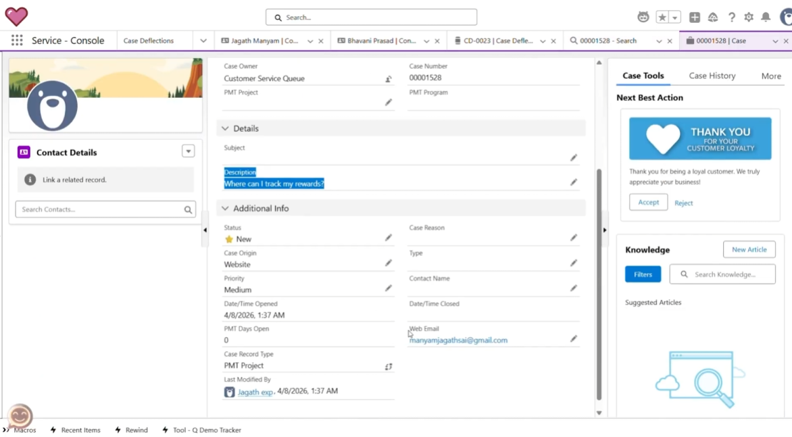
A case arrives with the customer’s original query and context already populated, not a blank form the agent has to interpret from scratch.
This inverts a familiar cost. In a form first portal, the agent’s first task is working out what the customer meant, and the customer usually has to explain it a second time. In a retrieval first portal that work is already done, and Omni Channel Routing has something reliable to route on. The case begins at the point where a human is genuinely needed. This is also where autonomous service agents that handle inquiries around the clock earn their place, because the handoff between automated resolution and human ownership is the part that has to be designed rather than switched on.
Keep the failed retrieval attached to the case. Grouped by topic across a quarter, failed retrievals are your content roadmap, written for you by your customers.
How to Measure Case Deflection Rate Without Misleading Yourself
The number most dashboards show is portal sessions that did not end in a case. That counts everybody who left, including everybody who left frustrated. Use a set of measures that can contradict each other instead.
| Metric | How to calculate it | What it protects you from |
| Confirmed deflection rate | Verified sessions with an explicit resolved confirmation, divided by verified sessions that contained a query | Counting people who simply left as successes |
| Deflection quality | Share of confirmed deflections rated above your chosen floor | A high deflection rate built on answers customers disliked |
| Repeat contact within seven days | Cases opened on a topic the same customer was deflected on that week | Deflections that were really deferrals |
| Retrieval failure rate by topic | Queries returning nothing above the confidence floor, grouped by topic | Guessing at which content to write next |
| Case mix shift | Share of created cases classified as genuinely complex, tracked month on month | Judging the programme on volume alone |
One expectation to set with stakeholders before go live. If deflection is working, average handle time on the remaining cases should rise, not fall. The simple work has left the queue and what remains is harder. Teams that promise a falling handle time alongside a rising deflection rate are measuring in two directions at once, and they will end up reporting a failure that is actually a success.
Where Case Deflection Projects Go Wrong in Implementation
Five patterns account for most of the disappointing outcomes:
- Building the portal before the knowledge base is fit to retrieve from. Retrieval augmented generation does not rescue thin content. It surfaces the thinness faster, and in front of customers.
- Treating deflection as a component to switch on rather than a data model decision about what gets recorded and where it lives.
- Leaving the knowledge gap backlog without a named owner after go live, so the improvement loop runs for one sprint and then stops.
- Committing to a deflection percentage before anybody has seen the real query mix. Set the target after the first month of recorded queries, not in the business case.
- Leaving guest access open with no measurement path, then wondering why reported deflection does not reconcile with the drop in case volume.
Getting the Design Right Before the Build Starts
Support that begins with a case record has already decided a human is required. Support that begins with understanding turns that into a decision rather than a default, and only the queries that genuinely need attention reach the team. Cloud Odyssey designs and builds these intelligent service experiences inside Salesforce, from the retrieval architecture and deflection instrumentation through to how support processes get consolidated onto a single platform. A fintech that reworked its customer query handling is one example of what this looks like once it is running in production.
If you are scoping this now, the choices made in the first two weeks decide whether the portal is still measurable a year from now. Send us a month of your query data and we will help you shape the architecture around what your customers are actually asking.
Frequently Asked Questions
Not in every case. An Agentforce Data Library can index Knowledge articles and attachments and ground responses on its own. Data Cloud becomes necessary when you need to retrieve across sources beyond Knowledge, control exactly which chunks are returned to the model, or unify customer context that lives in systems outside Salesforce.
Coverage matters far more than volume. Map your highest frequency query topics from the last six months of case data, then check whether each one has a current, accurate and self contained article. Twenty well-written articles covering eighty percent of query volume will deflect more than two hundred articles spread across topics nobody asks about.
The first meaningful read usually comes at four to six weeks, once enough verified sessions have accumulated to separate topic patterns from noise. The larger gains arrive in the second and third quarter, because they come from the content improvement loop rather than from the launch itself.
More often it changes what the team spends its time on. Deflection removes repetitive low complexity volume, which usually shows up as reduced overtime, shorter backlogs and the capacity to absorb growth without hiring, rather than as an immediate headcount reduction. Organizations that plan for redeployment tend to get more from it than those that plan for cuts.
Expect the baseline to move. With simple queries removed, the remaining case mix is more complex, so average handle time and time to resolution often rise even as the customer experience improves. Rebaseline SLA targets against the post deflection case mix instead of comparing against historical figures that included the deflected volume.