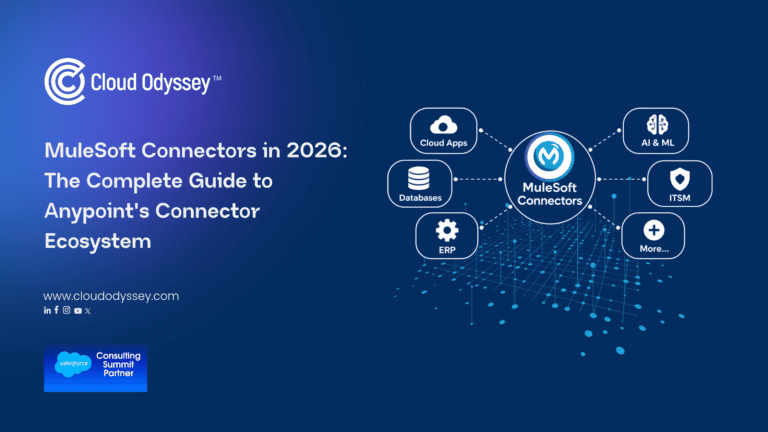

Every integration project starts with the same question: does a connector already exist for the system you need, or are you building one from scratch? For MuleSoft customers, three major connector releases between November 2025 and May 2026 changed that answer, deeper AI support, broader finance and ITSM coverage, and a faster path for business teams to build integrations without writing code.
This guide covers what MuleSoft connectors are, how many exist today, what’s new in the 2026 releases, and where they fit into a real integration strategy.
What Is a MuleSoft Connector?
A MuleSoft connector is a pre-built, reusable component that lets a Mule application or Salesforce Flow talk to an external system: a SaaS app, database, ERP, security tool, or AI model, without custom-coded integration logic. Each connector handles authentication, data formats, pagination, and error handling for its target system, so a developer or business user can drag it into a flow, configure a few fields, and start moving data. Connector logic is tested, versioned, and maintained centrally, so a change to a third-party API gets patched once instead of re-solved by every team that built against it.
Connectors fall into two families inside the Anypoint ecosystem:
- Anypoint Connectors — the developer-facing connector library used inside Anypoint Studio and Mule applications, covering hundreds of SaaS apps, databases, and protocols (REST, SOAP, JDBC), built for System, Process, and Experience APIs in an API-led connectivity architecture.
- MuleSoft for Flow: Integration Connectors — a low-code connector layer inside Salesforce Flow, built for business teams and admins connecting third-party systems without writing Mule code.
A MuleSoft developer builds the governed API layer in Anypoint Studio; a sales ops admin drags a NetSuite or QuickBooks connector onto a Flow canvas to automate quote-to-cash with clicks. Most enterprises run both, IT owns the API layer, business teams extend it for department-specific automation.
What’s New in MuleSoft’s 2026 Connector Releases
- Winter 2026 (Nov 2025): More than doubled the Flow connector library in one release, plus configurable record limits in Query Builder, single-record retrieval, and static collections. MuleSoft framed it as the foundation for “thousands of high-value use cases,” centered on Salesforce, NetSuite, and QuickBooks.
- 91 Connectors (Jan 2026): Deepened financial and operational backbones, Coupa for procurement, Microsoft Business Central for mid-market ERP, and broader quote-to-cash coverage.
- 40 Connectors (May 2026): Spread across five categories instead of deepening one, Business & Finance (QuickBooks GraphQL, Teamwork, Workable, Attio), Marketing & CX (Adobe Experience Platform, Iterable, Shippo), ITSM & Security (ThousandEyes, CrowdStrike, NetBox, Cisco Firewall Management), DevOps & IT (Postman, WireMock, ReadMe), and Productivity & Media (Zoom, BoldSign, PDF.co, Zuva AI).
That spread signals demand beyond IT and finance: marketing ops, security, and procurement teams that used to wait weeks for developer bandwidth on simple integrations.
MuleSoft AI Connectors: Connecting Agents to Enterprise Systems
Connector investment in 2026 is increasingly about standardizing how AI agents reach enterprise systems, not just SaaS-to-SaaS plumbing:
- MCP Connector exposes existing MuleSoft APIs as tools AI agents can call directly. A June 2026 update added elicitation (an agent asks a clarifying question instead of guessing at ambiguous instructions), structured output, and prompt templates.
- A2A Connector (Agent2Agent, built on Google’s open A2A protocol, GA since December 2025) lets AI agents discover, delegate to, and coordinate with other agents, working as both a client and a compliant server, so MuleSoft-managed agents can be called by agents built on other frameworks.
- Amazon Bedrock, Inference, and Vector Connectors let flows call foundation models and connect to vector stores, forming the backbone for RAG and semantic search inside MuleSoft applications.
- Einstein and Agentforce Connectors bring Salesforce’s Einstein Trust Layer into Anypoint Platform and let Agentforce agents trigger workflows and update external records in real time.
MuleSoft Connector Use Cases by Business Function
- Finance and ERP: The QuickBooks (GraphQL) connector syncs project updates to financial records, keeping budgets aligned with resource management instead of reconciling manually at month-end.
- Marketing and CX: Adobe Experience Platform retrieves audience segments and updates profiles on real-time loyalty triggers; Iterable turns that into a personalized campaign across channels. Separately, Shippo compares shipping rates while BoldSign sends e-signature links to finalize agreements.
- ITSM, Security, and DevOps: Pairing ThousandEyes (monitoring) with Logz.io (log alerting) silences non-critical notifications during active troubleshooting, a direct fix for alert fatigue. NetBox documents and provisions network paths from a flow; Postman provisions workspaces as projects start; a secrets-scanning and schema-validation pairing gates services before production. CrowdStrike and Cisco Firewall Management joined this release too, though MuleSoft’s notes don’t detail a specific combined workflow for them.
- Document and Productivity Workflows: Docspring, PDF.co, BoldSign, Files.com, and Zuva AI arrived without a published combined workflow; a reasonable extension is generating a document, finalizing it as a PDF, routing for signature, and archiving it, though that’s our extrapolation, not a documented MuleSoft use case.
Connectors Alone Aren’t Enough: Governing AI Agents at Scale
A connector gets an agent into a system; it doesn’t decide whether that agent should act once it’s there. That’s the gap MuleSoft Agent Fabric closes: a control plane that catalogs agents, MCP servers, and tools in the Agent Registry for discovery and reuse, routes tasks to the best-suited agent through the Agent Broker, enforces security and compliance policies on every agent interaction through Flex Gateway, and gives real-time visibility into the agent network through the Agent Visualizer. For organizations on MuleSoft Hyperforce infrastructure in regulated markets, this also intersects with data residency requirements worth mapping out before an agent gets access to a new connector.
Why Connector Strategy Matters
- Time to first integration drops — a connector that already exists turns a multi-week build into a configuration task measured in days.
- Maintenance shifts off your team — MuleSoft patches connector logic when a third-party API changes; custom REST calls mean patching it yourself, every time.
- Business teams stop waiting on IT — MuleSoft for Flow connectors let non-developers build integrations that would otherwise sit in a backlog.
One online marketplace credited MuleSoft’s Anypoint Platform and its reusable connectors with completing 33% more integration projects using the same headcount.
Frequently Asked Questions
A connector is pre-built and maintained by MuleSoft or a certified partner, already handling authentication and error handling for a specific system. A custom integration means writing that logic from scratch and maintaining it whenever the target API changes.
MuleSoft’s Anypoint Connector library covers hundreds of SaaS applications, databases, and protocols (no exact figure published). The MuleSoft for Flow connector library reached 90+ after Winter 2026, then added 91 (January) and 40 (May), an estimated 221 total, based on adding MuleSoft’s own announced figures.
It exposes existing MuleSoft APIs as tools an AI agent can call directly, letting agents browse, query, and take action across connected systems without custom code per integration.
MCP is agent-to-system: one agent using a MuleSoft API as a tool. A2A is agent-to-agent: multiple specialized agents discovering each other and coordinating on multi-step work.
Yes, through MuleSoft for Flow: Integration, admins can drag connectors onto a Salesforce Flow canvas and configure them with clicks. Complex, high-governance integrations still typically involve a MuleSoft developer working in Anypoint Studio.
Cloud Odyssey’s Take
Three connector releases in six months matters less for the count than for the pattern underneath it: MuleSoft is building connector infrastructure for a world where AI agents, not just people, trigger integrations. The MCP and A2A connectors are the clearest signal of that shift. But what we see most often with clients isn’t a shortage of connectors — it’s a mismatch between what’s available and how it’s governed. A connector makes a system reachable; it doesn’t decide who should reach it, what an AI agent should see once inside, or how a flow should behave when two systems disagree. That’s the architecture and governance work where most connector-based projects actually stall.
As a certified Salesforce and MuleSoft partner, Cloud Odyssey has designed API-led integrations across finance, retail, healthcare, and manufacturing, work reflected in a 45% improvement in integration and API reuse rate, 30% lower maintenance costs, and 35% faster time to market across our MuleSoft implementations. If you’re weighing which connectors fit your stack, or how to govern an AI agent strategy before it outgrows what you can audit, talk to a MuleSoft integration expert at Cloud Odyssey.