
Support leaders have a math problem. Salesforce’s research shows 65% of service leaders expect case volume to rise this year, while 58% expect headcount to grow. Hiring alone won’t close that gap, but customer service automation can narrow it. That is the job Agentforce Service was built to do.
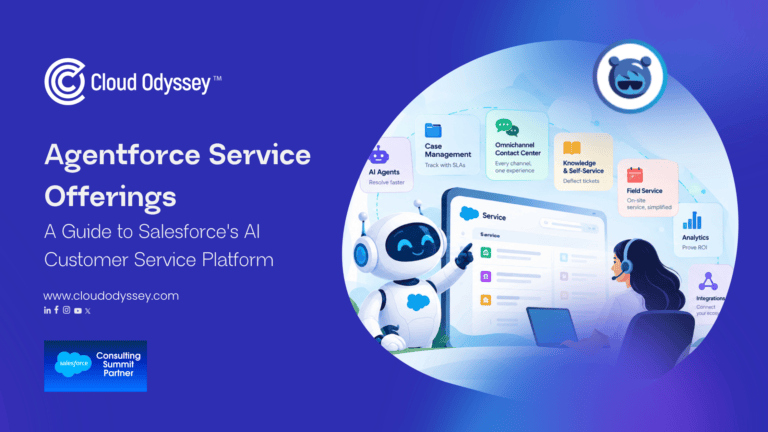
This guide covers each Agentforce Service offering: AI agents, case management software, omnichannel customer service, an AI knowledge base, field service management software, customer service analytics and integrations. For each one, we explain what it does, what it depends on, and where teams tend to stumble.
What Is Agentforce Service?
Agentforce Service is Salesforce’s AI customer service platform, renamed from Service Cloud in October 2025. It combines case management, omnichannel routing, knowledge and autonomous AI agents on the Salesforce Platform, with Data 360 (previously Data Cloud) as the data layer.
If you searched for Salesforce Service Cloud and landed here, you’re in the right place. The core product still manages cases, queues, entitlements and channels. The change is the layer on top: AI agents that resolve routine requests and hand complex ones to people with the full conversation attached.
Salesforce reports that the platform offloads up to 72% of routine inquiries to AI agents, with 32% faster resolution and an estimated 33% lift in CSAT. Those are Salesforce’s own FY26 figures, so treat them as a ceiling to test against, not a promise. Our full Agentforce Service overview covers the rename in more detail.
Agentforce Service Offerings at a Glance
| Offering | What it does | Good fit for |
| Help Agent and Service Agent | Resolve customer questions across chat, voice, email and portals | High-volume, repeatable requests |
| Case management | Turns every inquiry into a tracked case with SLAs | Any support team |
| Omnichannel contact center | Routes work from every channel to the right rep or agent | Teams on voice, WhatsApp, email and chat |
| Knowledge and self-service | Grounds AI answers and powers the customer portal | Teams trying to cut ticket volume |
| Field service | Schedules technicians and manages work orders | Service that happens on site |
| Analytics | Measures human reps and AI agents together | Leaders who need proof of ROI |
| Integrations | Connects ERP, telephony and other systems | Complex tech stacks |
AI Agents for Customer Support: Help Agent and Service Agent
Agentforce offers two ways to deploy an AI customer service agent. Help Agent is prepackaged and goes live from one setup screen. Service Agent is the configurable option, where you define topics, instructions and actions yourself.
Salesforce made Agentforce Help Agent generally available in July 2026, with pay-per-resolution pricing. Its proof point is help.salesforce.com, which Salesforce says handled 4.3 million inquiries and resolved 70% of them without a person. That is Salesforce’s own portal, run by the people who built the product. A typical org with an uneven knowledge base should expect a lower number at first.
The Help Agent guided setup needs Enterprise or Unlimited Edition with Agentforce enabled. You ground it on Salesforce Knowledge, uploaded files or a website sync. We often see teams choose Help Agent for a first deployment and move to a custom Service Agent when they need order lookups, appointment changes or other actions tied to their own systems.
The agents also work in other languages. Our walkthrough on building a multilingual AI agent with Agentforce shows how a Hinglish order-status question gets handled.
Customer Service Automation and Agentic AI Orchestration
Customer service automation in Agentforce Service means AI agents, Flow and rules handle routine work, such as status updates, routing and summaries, while people handle judgment calls.
A few capabilities do most of the work here:
- Agentic Milestones. Introduced in the Summer ’26 release, they let you mark SLA milestones as agentic. Agentforce then drafts and sends routine updates based on rules you set in Prompt Builder. Reps stop typing the hundredth “we’re still on it” message.
- Flow and Omni-Channel routing. These decide whether a request goes to an AI agent, a queue or a named rep.
- Model Context Protocol (MCP) support. Agents can reach outside systems through an open standard, so checking inventory in an ERP becomes a configuration task instead of a build.
- Multi-agent setups. Salesforce describes a customer service superagent that orchestrates specialist agents for products, orders and loyalty. Agentic orchestration matters once one agent can’t hold every job.
Start with one narrow queue. A single well-defined use case teaches you more than a broad launch that nobody can measure.
Case Management Software Built Into Agentforce Service
Agentforce Service turns every email, chat, call or social message into a case with its full interaction history, then tracks it against entitlements and SLA milestones.
Case management software is the part of the platform most teams already know. The data model is familiar to any Service Cloud admin: accounts, contacts, cases, case comments, knowledge, entitlements, milestones, queues and macros. Agentforce adds Agent, Topic and Action records on top, which define what an AI agent may do.
The service rep workspace replaces the old multi-tab console. Reps see purchase history, past cases and product usage on one screen, with inline guidance that updates as the conversation moves. Email-to-Case can also be set up so an Agentforce Service Agent handles incoming email.
If you’re planning a rollout, our Salesforce Service Cloud implementation services page lays out how we scope it.
Omnichannel Customer Service and the Cloud Contact Center
Omnichannel customer service in Agentforce Service routes work from voice, messaging, email and web to the right agent or rep through Enhanced Omni-Channel, with a supervisor command center on top.
Salesforce’s own setup guidance calls Enhanced Omni-Channel the foundation for Agentforce Service. It’s also required if you plan to use Agentforce Voice or Agentforce Contact Center. Command Center for Service sits on top, giving supervisors a live view of conversations across human and AI agents so they can step in when a customer needs a person.
For a cloud-based omnichannel contact center, the Salesforce Help documentation covers:
- Agentforce Contact Center and Partner Contact Center, with voice through Amazon Connect or partner telephony
- Messaging channels including Enhanced Chat, SMS, Apple Messages for Business and WhatsApp
- WhatsApp Pay screen flows for India
- Real-time translation for chat and email
- Workforce Engagement tools for forecasting, shift scheduling and quality management
One deadline matters: Salesforce is retiring Standard Facebook Messenger and Standard SMS channels in mid-2026. If you haven’t moved to Enhanced channels, that work is overdue.
Budget is a common worry for smaller teams. Salesforce India’s current homepage promotes an SMB Growth Kit that it says can go live in four weeks, which puts affordable omnichannel support within reach of SMEs.
AI Knowledge Base and Knowledge-Centered Service
An AI knowledge base in Agentforce Service feeds Salesforce Knowledge articles to AI agents and the customer portal. The quality of those articles sets the quality of the answers.
Knowledge-centered service (KCS) is the habit of writing and fixing articles while you solve cases, instead of in a quarterly cleanup. It matters more now. An AI agent that reads a stale article will repeat the error to every customer who asks.
The redesigned self-service portal answers natural-language questions and can walk a customer through a multi-step task. If case deflection is your goal, read our guide on how to design an intelligent case deflection portal in Salesforce.
Field Service Management Software and Work Order Management
Agentforce Service extends to the field through Salesforce Field Service, which manages work orders, technician skills, scheduling and mobile workforce management inside the same platform as your cases.
Salesforce describes the platform as covering every type of service, from the contact center to the field. In practice, a case can spawn a work order, and a technician with the right skill gets scheduled against it. The developer documentation shows how service resources, skill requirements and work orders connect. Salesforce’s own page explains work order management software if you’re comparing options.
This is where integration pays off. A service rep who can see the open work order, the technician’s schedule and the customer’s history answers questions without a transfer.
Customer Service Analytics and Reporting
Agentforce Service analytics measures human reps and AI agents in one dashboard, so you can compare resolution, quality and cost without reconciling two reports.
Service Agent Analytics and Employee Agent Analytics now share a dashboard with more than 40 metrics. Custom Scorers, currently in beta, let you grade agent sessions against your own KPIs. For voice, chat and messaging, Salesforce Help documents omni-channel analytics dashboards and contact center reporting.
Pick three numbers before launch: autonomous resolution rate, escalation rate and CSAT on AI-handled cases. If you can’t baseline them today, a Salesforce CRM health check is a sensible first step.
CRM Software Integration and Call Center Integration with MuleSoft
Agentforce Service connects to ERP, telephony and other systems through MuleSoft APIs, Salesforce Flow and MCP, so agents can act on data that lives outside Salesforce.
An AI agent that can only read Salesforce data hits a wall fast. Customers ask about shipments, invoices and warranties that sit in other systems. CRM software integration through MuleSoft closes that gap, and call center integration with your telephony provider keeps voice in the same record.
Security needs the same attention. Our post on MuleSoft Agent Fabric covers how to govern which agents can reach which systems. For Indian data residency, see MuleSoft on Hyperforce in India.
How Much Does Agentforce Service Cost?
Agentforce Service pricing mixes per-user licences, Flex Credits and, for Help Agent, a per-resolution charge. On Salesforce’s US pricing page, Help Agent costs $2 per resolution.
The same page lists the Agentforce Service Portal at $4 per login or $10 per member. Salesforce’s India service page lists Agentforce 1 Service with 2.5M Flex Credits per org per year. Prices differ by region and edition, so confirm current India pricing with your Salesforce account team before you build a business case.
Agentforce Service vs. Sales Cloud
Sales Cloud is now Agentforce Sales. The split is simple: Agentforce Sales manages pipeline up to the purchase, and Agentforce Service manages the customer relationship from that point on. Most companies run both. If you’re weighing which to start with, our Sales Cloud implementation page covers the sales side.
Cloud Odyssey’s Point of View
We’ve helped enough teams through this move to see the same pattern. They get excited about the AI agent and skip the groundwork that makes it reliable.
Here is what we tell clients:
Fix the data first. Duplicate accounts, inconsistent case fields and a knowledge base nobody has touched since 2021 produce an agent that sounds sure and answers wrong. We run a CRM health check before we switch on agentic features.
Launch one queue, not the whole contact center. Pick a high-volume, low-risk request type, measure it for a month, then widen the scope. CurrencyFair did this with its query-handling process on Agentforce.
Budget for after go-live. Salesforce ships three releases a year, and agents need tuning as products and policies change. Our managed services team handles that work.
Cloud Odyssey is a Salesforce Summit partner and a MuleSoft partner, named Multi-Cloud Partner of the Year 2026 by Salesforce India. Our team has earned more than 40 AI certifications, and we’ve built digital agents for clients like VEV Romerike. If you want a straight answer on what Agentforce Service will do for your case volume, talk to our Salesforce Service Cloud team. You can also explore our Agentforce services, Salesforce consulting and implementation services.
FAQs About Agentforce Service
Agentforce Service is Salesforce’s AI customer service platform for case management, omnichannel support, knowledge and autonomous AI agents. Salesforce renamed it from Service Cloud in October 2025.
Yes. It’s the same product under a new name, with an AI layer added. Existing orgs keep their data and automations, but the newer agentic features need the right licence and some setup.
Help Agent is prepackaged and goes live from one setup screen. Service Agent is configurable, so you define its topics, instructions and actions.
Core case management works without it. AI features such as agentic case handling and Help Agent setup depend on Data Cloud (Data 360) and Agentforce being enabled, and they work best on clean, unified data.
Yes. Salesforce Field Service connects work orders, technician skills and scheduling to the same platform as your cases.
Audit your data and knowledge base, set up Enhanced Omni-Channel, launch one AI agent on a single queue, then measure and expand. Cloud Odyssey’s implementation services follow this path.