
Dreamforce 2026 ran September 15–17 in San Francisco, and the headline news was AIforce, a new interface layer that lets people work with Salesforce data from inside Claude, Slack, or Lightning instead of logging into the CRM directly. Salesforce also introduced Koa, its first purpose-built CRM reasoning model, and rolled out a broad Customer 360 update spanning sales, service, marketing, commerce, and revenue operations. Below, we break down what was announced, why it matters, and what it means for teams planning their next Salesforce investment, plus Cloud Odyssey’s point of view for enterprise leaders.
Last year’s event set the stage with Agentforce 360 and the idea of the Agentic Enterprise. If you missed it, our Dreamforce 2025 recap is worth a read alongside this one, Dreamforce 2026 builds directly on that groundwork.
What Is Dreamforce 2026? A Quick Recap
Dreamforce is Salesforce’s annual customer and developer conference, held at the Moscone Center in San Francisco. The 2026 edition drew roughly 53,000 attendees on-site, with over 10,000 people in the keynote hall and millions more streaming the sessions on Salesforce+. Marc Benioff opened the main keynote alongside NVIDIA CEO Jensen Huang, Anthropic co-founder Dario Amodei, OpenAI CEO Sam Altman, and Siemens CEO Roland Busch, among others.
Where Dreamforce 2024 introduced Agentforce and Dreamforce 2025 expanded it into Agentforce 360, Dreamforce 2026 did not center on a single flagship product. Instead, Salesforce presented a connected set of releases, AIforce, Koa, and a wide Customer 360 refresh, all aimed at one goal: letting Agentforce agents work wherever people already work, rather than forcing everyone back into a single application window.
Key Takeaway 1: AIforce Lets Salesforce Live Inside Claude, Slack, and Beyond
The biggest reveal of Dreamforce 2026 was AIforce, a new agentic interface layer built on top of Agentforce, Data 360, and Customer 360. Benioff framed it as the latest step in a long line of interface shifts, from the command line to the graphical interface, to the web, to mobile, and now to conversational AI.
AIforce pulls from Salesforce’s metadata layer to assemble a working view of the business on demand, instead of relying on a fixed screen layout. In practice, that means an employee can update a record, trigger a workflow, or ask a question about pipeline without ever opening the Salesforce app. The AIforce package has four parts:
- Claudeforce — the expanded partnership between Salesforce and Anthropic, including a Salesforce plugin for Claude with more than 35 prebuilt sales skills, now in open beta.
- Slackforce — Salesforce context and live visualizations surfaced directly inside Slack channels.
- Agentforce Coworker — an AI teammate that sits inside the Lightning interface.
- The Headless Toolkit — the developer layer of MCP servers, APIs, plug-ins, and skills that builders use to connect Agentforce to outside tools.
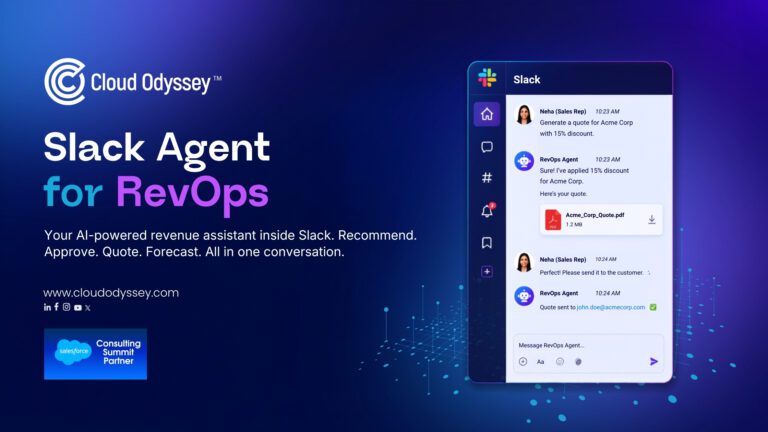
For organizations that lean on Slack as their operational hub, this is a natural extension of a trend Cloud Odyssey called out in our Slack agent for RevOps work last year: the CRM interface is becoming less important than the CRM’s data and workflow logic, which now travels to wherever the user is.
Salesforce paired the AIforce launch with a pointed statement on data handling: business data used to answer a question inside Claude or another connected tool is not retained or used to train outside models. That zero data retention stance matters for regulated industries evaluating Financial Services Cloud or Manufacturing Cloud deployments, where data residency and model training policy are frequent points of scrutiny during procurement.
Key Takeaway 2: Koa Is Salesforce’s First CRM Reasoning Model
Alongside AIforce, Salesforce and NVIDIA unveiled Koa, Salesforce’s first CRM-specific reasoning model built for Agentforce. Rohan Kumar, Salesforce’s President and Chief Platform and Engineering Officer, explained that Koa is a post-trained version of NVIDIA’s open-weight Nemotron 3 Super model, tuned on a synthetic dataset drawn from close to three decades of CRM deployment knowledge across more than 14 industries. No customer data went into the training set.
On Salesforce’s internal CRM Benchmark, a set of real-world tasks like updating an opportunity, routing a case, or scheduling a follow-up, Koa reportedly matches or beats leading general-purpose models while producing three times fewer errors. Independent benchmarking put Koa ahead of GPT-4.1 on the Tau2Bench customer service test, though still behind GPT-5.5, which underlines the point Salesforce is making: Koa is not designed to be the smartest model in the world, it is designed to be the most reliable one for repetitive, multi-step CRM work.
The Koa partnership also extends to Missionforce, Salesforce’s offering for government and regulated organizations, bringing Nemotron-based models and accelerated computing into private cloud and air-gapped environments.
Why this matters for your Agentforce roadmap: Koa gives customers a specialized, Salesforce-hosted reasoning option that sits alongside Claude and OpenAI models rather than replacing them. Model choice is becoming an architecture decision, which model handles which workflow, and who is accountable for that choice, a question our Salesforce Consulting Services team walks clients through during agent design.
Key Takeaway 3: Customer 360 Gets a Sweeping Agentic Update
Patrick Stokes and the product team announced updates spanning nine areas of Customer 360:
- Sales Cloud and Service Cloud picked up deeper Agentforce integration for pipeline management and case handling.
- Marketing Cloud gained agent-driven personalization across campaigns.
- Commerce Cloud introduced a shopper agent and agentic commerce search, along with headless B2B commerce capabilities.
- Field Service added a scheduling agent and voice-to-form support across multiple languages.
- Frontline workforce management moved into Slack for shift and task coordination.
- IT Service Management gained a configuration management database (CMDB) and service graph for infrastructure-aware case resolution.
- Revenue Cloud picked up new revenue-specific skills and MCP tool support.
This is a wider release than a single product launch, it reads as Salesforce pushing agentic capability into every corner of Customer 360 at once, rather than concentrating it in Sales and Service alone. For industries running Retail Cloud or Consumer Goods Cloud, the Commerce Cloud shopper-agent updates in particular are worth a closer look during your next release-planning cycle.
Key Takeaway 4: Trust Still Comes Before Autonomy
Every major Salesforce keynote since Agentforce launched has repeated the same message: agents only scale when governance keeps pace with autonomy. Dreamforce 2026 was no different. Benioff again stressed that Salesforce data does not train third-party models and that the company runs recurring internal audits of that policy.
That message landed against a slightly awkward backdrop: Salesforce experienced a global service disruption on the same day as its main product announcements, which locked some customers out of their orgs mid-conference. It is a useful, if unplanned, reminder that platform reliability and governance are not separate conversations from AI ambition; they are the same conversation. As agent volume grows, the organizations that get the most value are the ones that treat monitoring, access control, and system health as part of the AI rollout plan, not an afterthought. This is exactly the gap our Salesforce CRM Health Check Services and Salesforce Managed Services are built to close before and after go-live.
Key Takeaway 5: Salesforce Is Betting on Multiple AI Models, Not One
A quieter but consequential theme at Dreamforce 2026 was Salesforce’s shift toward a multi-model strategy. Anthropic’s Claude now powers AIforce and Claudeforce. NVIDIA’s Nemotron underpins Koa. OpenAI’s Sam Altman joined Benioff on stage to discuss an existing partnership that already brings GPT-based models into Agentforce and ChatGPT.
Rather than picking a single foundation model, Salesforce is positioning itself as the trust and data layer that sits underneath whichever model a customer’s workflow needs: a specialized reasoning model for routine CRM tasks, a frontier model for open-ended reasoning, and a conversational interface for day-to-day work. For customers, that shifts the integration conversation from “which AI vendor do we pick” to “which model fits which business process,” which is a data governance and platform architecture question as much as an AI one, an area where MuleSoft integration and unified Data Cloud architecture do the heavy lifting.
Key Takeaway 6: The Adoption Numbers Are Getting Harder to Ignore
Salesforce shared that Agentforce has grown to roughly 30,000 customers, with billions of agent actions completed to date. Live customer demonstrations from Siemens and Adecco showed agents handling partner enablement and workforce operations in production, not in a lab environment. That mirrors the pattern we flagged in last year’s recap, Williams-Sonoma, PepsiCo, Dell, and FedEx were already running Agentforce at scale in 2025. A year later, the story has shifted from “early adopters prove it works” to “adoption is now the default expectation” for large Salesforce customers.
What Dreamforce 2026 Means for Enterprise Leaders
For CIOs: AIforce and the Headless Toolkit mean agent access points now extend well past the Salesforce UI. Access governance, MCP server security, and data lineage need a fresh review before agents start acting from Slack or Claude.
For CMOs and Commerce leaders: The Marketing Cloud and Commerce Cloud updates push personalization and shopper agents further into the buying journey. The opportunity is real, but it depends on clean, unified customer data, not fragmented records across systems.
For COOs: Field Service, Frontline workforce management, and the new ITSM service graph point toward operations teams running more of their day-to-day coordination through agents inside Slack rather than through dashboards.
For RevOps and Sales leaders: Revenue Cloud’s new skills and MCP support, paired with Koa’s CRM-specific reasoning, give sales teams a more reliable agent for repetitive pipeline tasks, freeing reps for the parts of the deal cycle that still need a human.
Dreamforce 2026 confirmed a shift we have been watching build for two years: the Salesforce interface itself is becoming optional, while the data model, governance layer, and agent orchestration underneath it are becoming the real product. AIforce and Koa are both, at their core, an argument that the value Salesforce has built over 27 years is not the screen you log into, it is the trust, the workflow logic, and the CRM-specific knowledge baked into the platform.
That argument holds up only if the underlying implementation is solid. A multi-model, multi-interface architecture magnifies the cost of a messy data model or an ungoverned integration; it does not fix it. Before adding AIforce, Koa, or a new Customer 360 agent to next year’s roadmap, most organizations get more value from a structured review of their current Salesforce setup, their Data Cloud foundation, and their access controls than from chasing every announcement out of Moscone Center.
Our recommendation for teams planning FY27 initiatives: treat AIforce and Koa as a reason to revisit your data governance and integration architecture, not just a new feature to switch on. That is the work we do with clients through our Salesforce Implementation Services and Salesforce Consulting Services, building the foundation that makes each new Agentforce release additive instead of disruptive.
Frequently Asked Questions
Dreamforce 2026 is Salesforce’s annual customer and developer conference, held September 15–17, 2026, at the Moscone Center in San Francisco. The event featured keynotes on Salesforce’s Agentic Enterprise strategy, alongside product announcements including AIforce, Koa, and Customer 360 updates.
AIforce is Salesforce’s new interface layer, announced at Dreamforce 2026, that lets users interact with Salesforce data and workflows from Claude, Slack, or Lightning without opening the core Salesforce application. It includes Claudeforce, Slackforce, Agentforce Coworker, and a Headless Toolkit for developers.
Koa is Salesforce’s first purpose-built CRM reasoning model, developed with NVIDIA on the Nemotron 3 Super architecture. It is trained on synthetic data modeled after nearly three decades of CRM deployment patterns and is designed to handle multi-step CRM tasks such as updating opportunities and routing service cases with fewer errors than general-purpose models.
Agentforce is Salesforce’s platform for building and running autonomous AI agents inside the CRM. AIforce is the interface layer that lets those agents, along with users, work from outside applications like Claude and Slack, rather than the Salesforce UI itself. Agentforce is the engine; AIforce is how people and agents reach it.
The biggest Dreamforce 2026 announcements were AIforce (Salesforce’s new cross-platform interface layer), Koa (its first CRM reasoning model, built with NVIDIA), and a broad Customer 360 update covering Sales, Service, Marketing, Commerce, Field Service, and Revenue Cloud.
Salesforce maintains a zero data retention policy for AIforce and its connected models. Business data is used to generate a response but is not stored or used to train the underlying model, according to statements made at the Dreamforce 2026 keynote.