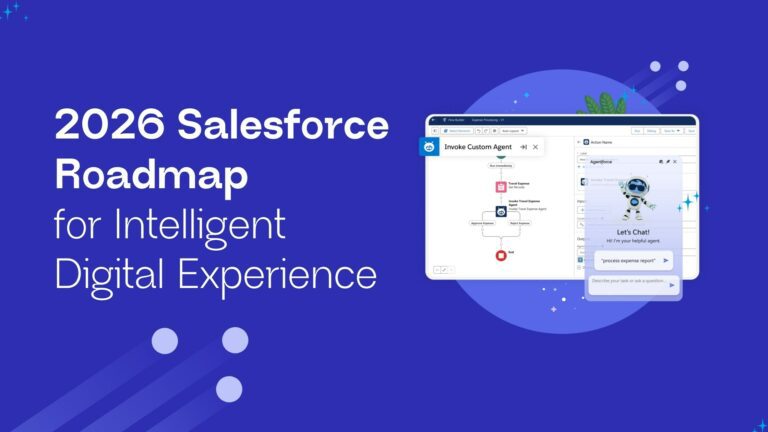

Salesforce Agentforce represents a shift from assistive AI tools to autonomous AI agents that can reason, act, and execute tasks across enterprise workflows. Introduced as part of Salesforce’s next phase of artificial intelligence, Agentforce goes beyond copilots by enabling intelligent agents to independently support sales, service, marketing, commerce, and operational teams.
Unlike traditional automation or rule-based bots, Salesforce Agentforce AI agents operate using trusted enterprise data, built-in governance, and secure access controls. This makes Agentforce particularly relevant for organizations looking to scale customer interactions, reduce manual effort, and improve operational efficiency without compromising data security.
What Is Salesforce Agentforce and Why It Matters Now
Agentforce is Salesforce’s autonomous AI agent platform designed to help organizations move from AI assistance to AI-driven execution. Announced on August 28, 2024, Agentforce is positioned as part of Salesforce’s “Third Wave of AI,” focusing on accuracy, trust, and real business outcomes.
As enterprises manage increasing volumes of customer interactions and operational complexity, Agentforce enables AI agents to handle tasks independently while operating within Salesforce’s security, data, and governance framework. This allows teams to focus on higher-value work while AI agents manage routine and repetitive processes.
How Salesforce Agentforce AI Agents Work
At its core, Salesforce Agentforce is a suite of autonomous AI agents that leverage trusted data, reasoning engines, and enterprise-grade security to perform actions across Salesforce applications.
Key components include:
- Atlas Reasoning Engine, which enables agents to analyze context and make informed decisions
- Einstein Trust Layer, ensuring secure data usage and governance
- Data Cloud integration, allowing agents to access real-time, unified customer data
These AI agents do not simply respond to prompts. They can take meaningful actions such as resolving service cases, qualifying leads, optimizing campaigns, and assisting with commerce workflows.
Salesforce Agentforce Use Cases Across Business Functions
Salesforce Agentforce AI agents can be deployed across multiple departments to support enterprise operations.
Agentforce for Customer Service
Agentforce agents can handle customer inquiries, resolve issues, and provide personalized support at scale. When human intervention is required, agents intelligently escalate cases while maintaining data security and context.
Agentforce for Sales Teams
Sales AI agents assist with lead qualification, meeting scheduling, follow-ups, and pipeline management. This helps sales teams focus on closing deals rather than administrative tasks.
Agentforce for Marketing Operations
Marketing teams use Agentforce to create content, manage campaigns, analyze customer behavior, and optimize engagement across channels.
Agentforce for Commerce and Retail
Agentforce enhances commerce experiences by automating order processing, optimizing product recommendations, and preventing fraud, especially in high-volume retail environments.
Agentforce for Operations Finance and IT
Operational agents help manage resources, monitor systems, detect risks, and support internal teams with analytics and reporting.
Pre-Built Salesforce Agentforce Agents Explained
Salesforce provides several pre-built Agentforce agents that organizations can deploy quickly and customize as needed.
Service Agent
Handles customer inquiries around the clock using reliable enterprise data, with seamless escalation to human agents when required.
Sales Development Representative Agent
Engages prospects 24/7, answers product questions, schedules meetings, and supports multilingual and multi-channel interactions.
Sales Coach Agent
Helps sales representatives practice pitches, handle objections, and improve performance through role-based scenarios and feedback.
Personal Shopper Agent
Enhances digital commerce experiences by recommending products, assisting purchases, and improving conversion rates.
Campaign Agent
Supports marketing teams by generating campaign briefs, identifying audiences, creating journeys, and optimizing performance in real time.
Who Should Use Salesforce Agentforce and Who Should Not
Salesforce Agentforce is best suited for organizations that already have a mature Salesforce environment.
Ideal candidates include:
- Enterprises using Data Cloud or unified customer data
- High-volume sales, service, or commerce operations
- Organizations with defined governance and AI readiness
Agentforce may not be ideal for:
- Small teams with limited data maturity
- Organizations seeking simple chatbot solutions
- Businesses without clear automation use cases
Salesforce Agentforce vs Copilots Chatbots and Rule-Based Automation
Unlike copilots that assist users or chatbots that follow predefined rules, Agentforce AI agents can reason and take action independently.
- Copilots assist but rely on human execution
- Chatbots follow scripts and limited workflows
- Agentforce executes tasks using trusted data and enterprise logic
This distinction makes Agentforce suitable for complex enterprise use cases rather than surface-level automation.
Salesforce Agentforce Implementation Considerations
Successful Agentforce adoption requires careful planning.
Key considerations include:
- Data quality and Data Cloud readiness
- Security, governance, and compliance requirements
- Integration with Sales Cloud, Service Cloud, and Commerce Cloud
- Change management and user adoption strategies
Agentforce implementation is not a plug-and-play exercise. It requires alignment between business goals, data architecture, and AI governance.
Salesforce Agentforce Pricing ROI and Cost Considerations
Salesforce Agentforce pricing starts at $2 perconversation, with volume-based discounts available. While this can deliver strong ROI for high-volume use cases, costs can scale quickly depending on interaction volume.
Organizations should evaluate:
- Cost per interaction versus human effort
- Use case prioritization
- Long-term scalability and ROI
How Cloud Odyssey Helps Implement Salesforce Agentforce
Implementing Salesforce Agentforce successfully requires more than enabling AI agents. It requires strategy, architecture, and governance.
Cloud Odyssey works with organizations to:
- Identify high-impact Agentforce use cases
- Design secure and scalable AI architectures
- Align Agentforce with multi-cloud Salesforce environments
- Ensure governance, compliance, and long-term value
Conclusion
Salesforce Agentforce represents the convergence of humans, AI, data, and action. By enabling autonomous AI agents to operate securely within Salesforce, organizations can improve efficiency, scale operations, and deliver better customer experiences. When implemented with the right strategy and governance, Agentforce becomes a powerful driver of enterprise transformation rather than just another AI tool.